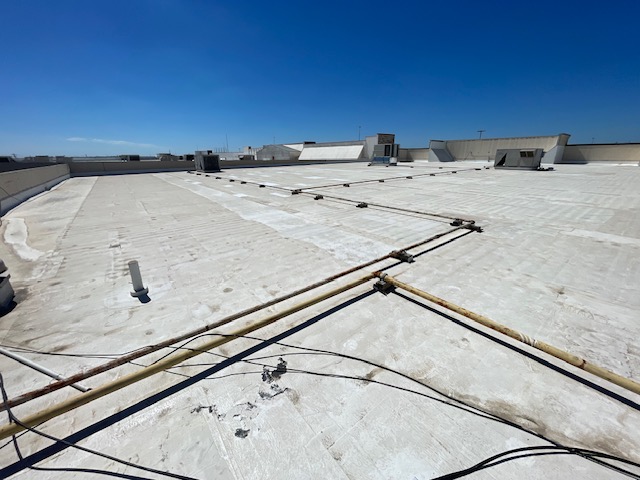
Skip to content
A leak shows up in a tenant’s ceiling. A storm rolls through and the roof looks fine from the parking lot. A repair you paid for two years ago is failing again. Sooner or later, every commercial property owner or manager faces the same question: do we fix this roof, or replace it?
It is an expensive question to get wrong in either direction. Replace too early and you spend capital you did not need to spend. Repair too long and you pay for patch after patch while water quietly damages insulation, decking, equipment, and the space below.
This guide walks through how to make the decision on a commercial roof in Austin, TX: what points toward repair, what points toward replacement, how your roofing system and Austin’s climate change the answer, and what to ask a contractor before you approve anything.
The Short Answer
Repair usually makes sense when the problem is localized, the source of the leak is identified, and the rest of the roofing system is in sound condition with meaningful service life left.
Replacement usually makes sense when damage is widespread, leaks keep returning in different places, moisture is trapped in the roof assembly, or the system has reached the end of its useful life.
The key phrase is condition, not just age. A roof is not automatically due for replacement because it has hit a certain number of years, and it is not automatically repairable because the damage looks small. A proper evaluation of the actual roof is what separates a smart decision from a guess.
Why This Decision Is Harder on a Commercial Roof
Commercial roofs are not simply bigger versions of residential roofs. Several things make the repair-or-replace call more complicated:
- Flat and low-slope design. Water does not shed as quickly as it does on a steep roof, so drainage, seams, and flashing carry much more of the load.
- Hidden water. Water can travel through roofing materials and insulation before it appears inside the building, so the stain on the ceiling is often not where the roof is actually failing.
- Rooftop equipment. HVAC units, vents, pipes, and skylights create penetrations and transitions, which are common leak points.
- Operations and occupants. Tenants, employees, customers, inventory, and equipment all sit below the roof, so the cost of a failure goes beyond the roof itself.
- Budget and planning cycles. Replacement is often a capital expense that needs to be planned, approved, and phased.
Because of this, the best decisions come from understanding what is happening across the whole roof system, not just at the visible leak.
When a Commercial Roof Repair Makes Sense
Repair is often the right call when most of the following are true:
- The damage is localized. The problem is confined to a specific area, such as a seam, a section of flashing, a penetration, a drain, or a single point of storm impact.
- The source has been identified. A good repair fixes the cause of the leak, not just the visible symptom.
- The surrounding roof is in usable condition. The membrane or panels around the problem area are not brittle, cracked, or deteriorating.
- Moisture has not spread widely. The insulation and deck beneath the roof are still dry or only affected in a small area.
- The system has real service life left. Repairing a roof with many good years ahead of it is often more cost-effective than replacing it early.
- Repairs have been holding. If past repairs have lasted, that is a good sign the rest of the system is performing.
Problems that are often repairable
- Failed or deteriorated flashing and transitions
- Open or damaged seams
- Leaks around penetrations such as vents, pipes, and equipment curbs
- Deteriorated sealants
- Localized punctures or impact damage
- Drain and drainage-area problems
- Isolated storm or debris damage
In these cases, a targeted repair can restore performance and extend the life of the roof without the cost and disruption of a full replacement.
When Replacement Makes More Sense
Replacement becomes the smarter investment when repairs are no longer solving the problem. Warning signs include:
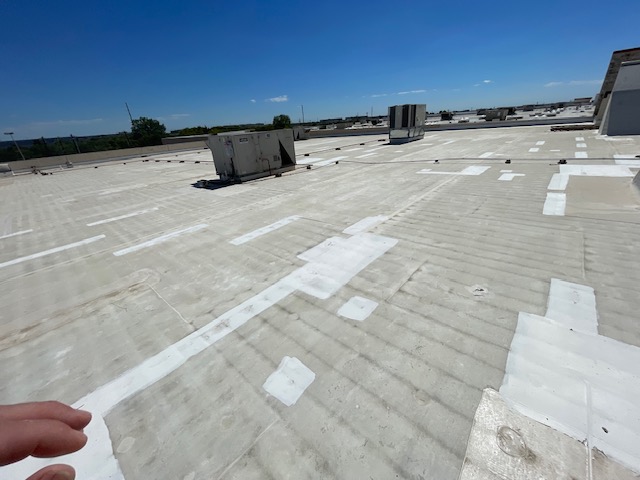
- Recurring leaks in different areas. If the roof leaks in one place, you fix it, and then it leaks somewhere else, the system may be failing broadly rather than at one spot.
- Widespread membrane deterioration. Cracking, blistering, splitting, shrinking, surface erosion, or seams that are separating across large areas.
- Wet or saturated insulation. Trapped moisture reduces performance, can spread, and often cannot be fixed with a surface patch.
- Deck or structural concerns. Damage to the roof deck or supporting components changes the scope of the work.
- Repairs are stacking up. A roof covered in patches, with repair after repair, is often a sign you are paying for the roof twice.
- The system is at or near the end of its service life. Even a roof without active leaks may be close to the point where problems accelerate.
- Extensive hail or wind damage. Widespread storm damage may affect enough of the roof that localized repairs are not practical.
- Previous repairs failed. If earlier fixes did not address the real cause, a more complete solution may be needed.
When these conditions are present, continuing to repair can cost more over time than replacing, and it leaves the building exposed to the risk of larger interior damage in the meantime.
The Repair Cost vs. Replacement Cost Rule of Thumb
One approach many property owners and roofing professionals use is to compare the cumulative cost of repairs over the past few years, and the repairs the roof is likely to need soon, against the cost of replacement. A commonly cited rule of thumb is that when repair costs start approaching a significant portion of the replacement cost, replacement deserves serious consideration.
Treat that as a starting point, not a formula. There is no universal percentage that fits every building. A fair comparison should also include:
- Interior damage and business disruption caused by repeated leaks
- Energy performance, since wet insulation can hurt a roof’s thermal performance
- Remaining service life of the roofing system if it is repaired
- Warranty and documentation considerations for the existing roof or a new one
- Your plans for the building, such as a sale, refinance, change in tenants, or planned capital projects
The goal is not to find the cheapest option this month. It is to find the lowest total cost of keeping the building protected over the time you plan to own and operate it.
How Your Roofing System Affects the Decision
Different commercial roofing systems age and fail in different ways. Service life varies widely with the material, installation quality, maintenance, and exposure, so it should be discussed based on your specific roof rather than a single number. The table below shows where each system commonly develops problems.
| Roofing system | Common trouble spots | What to watch for |
|---|---|---|
| TPO | Seams, flashing, penetrations, areas around rooftop equipment | Separating seams, damage near drains and equipment, localized punctures |
| EPDM | Seams, flashing, penetrations, aged membrane | Deterioration of the membrane, failed seam or flashing details, leaks at penetrations |
| PVC | Seams, flashing, connections around equipment | Failing seams or connections, damage near rooftop equipment |
| Modified bitumen | Seams, flashing, surface exposure | Weathering, damaged seams, deteriorated flashing, surface damage |
| Built-up roofing (BUR) | Multiple-layer assembly, surface finish, flashing | Visible deterioration, leaks, flashing problems, aging layers |
| Commercial metal | Panels, seams, fasteners, trim, equipment connections | Loose or failing fasteners, seam issues, flashing and trim problems |
In general, if the problems on a membrane roof are limited to seams, flashing, or penetrations, repair is often realistic. If the membrane itself is breaking down over large areas, replacement conversations get more serious.
If you are not sure which system you have, a roofer can identify it during an evaluation. The type of system also affects which repair methods are appropriate, so that identification matters.

How Austin’s Climate Changes the Equation
A commercial roof in Central Texas works under conditions that shape how it ages:
- Intense sun and heat. Long periods of UV exposure and high temperatures put constant stress on roofing membranes, sealants, and flashing.
- Hail. Hail can damage membranes, edges, flashing, and penetrations in ways that are not always obvious from the ground. Damage may not show up until a leak develops.
- Wind and severe storms. High winds can lift or displace roofing materials and damage edges, flashing, and areas around rooftop equipment. Debris can cause punctures.
- Heavy rain. Sudden, intense rainfall tests drainage systems. Poor drainage and ponding water on low-slope roofs can accelerate wear and cause leaks.
This is why a post-storm inspection is valuable even when the roof looks fine. Storm damage is not always visible right away, and having the roof evaluated and documented early can help you decide whether to repair, monitor, or plan for replacement. If hail may be involved.
Quick Self-Check: Signs Your Roof Needs Professional Attention
You do not need to be a roofer to notice early warning signs. Property managers and owners can watch for:
- Water stains on ceilings or walls, especially in the same spot more than once
- Active drips after rain
- Standing water on the roof that does not drain within a day or two after rain
- Visible cracking, blistering, splitting, or shrinking of the roofing surface
- Loose, lifted, or damaged flashing
- Debris, damaged areas, or displaced materials after a storm
- A musty smell or mold in the space below
- Tenant or employee complaints about leaks
- A growing history of repairs
Any of these is a reason to have the roof evaluated. Catching a problem early is often the difference between a targeted repair and a larger project.
What a Proper Commercial Roof Inspection Should Include
The quality of your repair-or-replace decision depends on the quality of the inspection behind it. A useful evaluation looks at the whole roof, not just the spot where water appeared inside. It typically considers:
- The condition of the roofing surface, membrane, or panels
- Seams and laps
- Flashing, edges, and roof transitions
- Penetrations and rooftop equipment connections
- Drains, drainage patterns, and any ponding
- Signs of previous repairs and how they are performing
- Indications of moisture in the roof assembly and, where appropriate, further investigation
- Interior signs of leaks
- Storm-related damage
- Photo documentation of what was found
The result should be a clear explanation of what the inspector found and a written recommendation: repair, maintenance, replacement, or another path, along with the reasoning. If an inspection ends with only a number and no explanation of the roof’s condition, ask for more detail.
Five Questions to Make the Call
When you have the inspection results, these five questions can bring the decision into focus:
- Where is water getting in, and can that source be fixed? If the cause is identified and repairable, repair is often realistic.
- How widespread is the damage? Isolated problems point toward repair; widespread problems point toward replacement.
- Is there trapped moisture in the roof assembly? Wet insulation or deck can change the scope of the work.
- How much service life remains, and how have past repairs held up? A roof with years left and stable repairs is a good repair candidate.
- What are your plans for the building over the next several years? Selling, refinancing, changing tenants, or planning capital projects can all affect the best choice.
Repair, Replace, or Something In Between?
The decision is not always strict either-or. Depending on the existing roofing system and its condition, there may be other approaches, such as a maintenance program, phased work, or other roofing solutions. Ask your contractor which options are realistic for your specific roof and why. A good contractor will explain the tradeoffs rather than steer you toward one answer by default.
For aging roofs that are still performing, a routine maintenance program can help monitor flashing, penetrations, drainage areas, membrane or panel conditions, sealants, areas with recurring leaks, and storm damage, so problems are caught early and replacement can be planned instead of forced by an emergency.
Questions to Ask a Contractor Before You Approve Anything
Whether you are leaning toward repair or replacement, ask these questions before signing:
- Who will actually perform the work? Ask whether the contractor uses its own crews or outsources the project to third-party labor.
- What is the scope in writing? The proposal should clearly describe the work and what is included.
- Which roofing system and materials are being proposed? The proposal should be specific, not just a generic new roof.
- How are existing conditions handled? Ask what happens if damaged decking, flashing, penetrations, or drainage problems are found during the project.
- How will the work be planned around the property? For occupied buildings, ask about scheduling, access, equipment, deliveries, parking, and phasing.
- What documentation and warranty information will you receive? You should know what is provided at project completion.
- Is the contractor properly insured and experienced with commercial roofing? Commercial systems and residential roofs are not the same.
- How was the recommendation reached? The contractor should be able to explain what they saw on your roof that led to the recommendation.
When comparing proposals, make sure you are comparing the same scope. A lower number may simply leave out work another proposal includes.
What to Expect If You Replace
Commercial roof replacement involves more planning than removing an old roof and installing a new one. A well-run project typically includes:
- Discussion of the property and goals. The roofer learns about the building, the roofing concern, and what you need from the project.
- Evaluation of the existing roof. Conditions that could affect the work are identified.
- Repair or replacement options. The condition of the roof determines which approach to consider.
- A written recommendation and proposal. The scope is documented so you can understand and compare it.
- Planning. Scheduling, building access, occupants, equipment, deliveries, parking, and phasing are coordinated before work begins.
- Installation. The agreed-upon work is completed.
- Final review. The finished work is reviewed, and applicable project documentation and warranty information are provided.
Larger or occupied properties may benefit from a phased plan that divides the work into manageable stages. Multifamily communities, for example, often involve multiple buildings, residents, common areas, and property managers. If that describes your property, see our information on multifamily roofing in Austin.
Common Mistakes to Avoid
- Patching without finding the source. Covering visible damage without identifying why water entered the roof often leads to repeat leaks.
- Deciding on age alone. Condition matters more than a number of years.
- Choosing only on the lowest price. Proposals with different scopes cannot be compared fairly on price alone.
- Skipping the inspection after a storm. Hail and wind damage may not be obvious until later.
- Waiting for interior damage. By the time water is visible inside, damage may already be spreading.
- Not keeping records. Documentation of inspections, repairs, and storm events helps with future decisions and conversations with insurers or buyers.
How Altitude Roofing Approaches the Decision
Altitude Roofing is a family-owned roofing company based in Austin with more than 20 years of Central Texas roofing experience. We are GAF Master Elite certified and fully insured, and our roofing work is handled by our own crews rather than outsourced third-party labor.
For commercial properties, we start by evaluating the existing roofing system and the source of the problem. From there, we explain whether repair, maintenance, replacement, or another approach should be considered, and we put our recommendation and proposal in writing so you understand the scope before work begins. We do not recommend replacement based on age alone.
For storm-related concerns, owner Mr Nichols holds an all-lines insurance adjuster license earned in 2006 and follows HAAG Engineering hail and windstorm inspection methods. Insurance coverage and claim decisions always depend on the property’s policy and circumstances.
Frequently Asked Questions
How do I know if my commercial roof needs repair or replacement?
It depends on how widespread the damage is, the age and condition of the roofing system, whether problems keep recurring, and whether moisture is trapped in the roof assembly. A professional assessment is the most reliable way to tell, because the cause of a leak is not always where the water appears inside.
Can a commercial roof be repaired if it leaks in more than one place?
Sometimes, if the leaks share a repairable cause, such as failed flashing or a series of similar penetration details. If leaks appear in many unrelated areas and the roofing material itself is deteriorating, replacement may make more sense.
How long does a commercial roof last?
Service life depends on the roofing material, installation quality, maintenance, roof design, and exposure to weather. It is best to discuss the expected life of your specific system rather than rely on one number for every commercial roof.
How much does commercial roof repair or replacement cost in Austin?
Costs vary widely based on roof size, existing conditions, material selection, accessibility, drainage and flashing details, tear-off and disposal needs, and any repairs discovered during the project. A property-specific written proposal is more useful than a generic price range.
Will insurance cover my commercial roof?
It depends on your policy, your carrier, and the circumstances of the loss. Storm-related damage may be worth documenting and discussing with your insurer. A roofing professional can evaluate and document the condition of the roof, but coverage decisions are made by the insurance carrier.
Should I get an inspection before deciding?
Yes. An inspection gives you a clear picture of the roof’s condition, the likely source of problems, and whether repair, maintenance, or replacement is the better path. It is useful even before a leak appears, especially after a hail or wind event or when planning for a future replacement.
Get a Clear Answer for Your Building
The right choice between repair and replacement is different for every roof. The surest way to avoid overspending or under-fixing is to start with an honest assessment of what is actually going on up there.
If you are dealing with a leak, storm damage, recurring repairs, or an aging roof, Altitude Roofing can evaluate your commercial roof and recommend the right next step.