Skip to content
A bundle of asphalt shingles typically weighs between 45 and 80 pounds. Three-tab shingles usually fall on the lighter end at 45–60 lbs per bundle, while architectural (laminated) shingles commonly weigh 60–80 lbs per bundle. Premium and designer shingles can exceed 80 lbs. There is no single universal weight , the exact number depends on the shingle type, the product line, and the manufacturer’s packaging specifications.
If you just needed that number, you have it. But if you’re like most homeowners who search this question, the weight of one bundle is only the beginning. What you really want to understand is how that number scales , how bundles relate to roofing squares, how much an entire roof’s worth of shingles weighs, how many bundles fit on a pallet, and how to calculate all of this for your own project.
How Much Does a Bundle of Shingles Weigh?
A shingle bundle doesn’t have one universal weight. The honest answer is a range, and the range depends mainly on the type of shingle:
| Shingle Type | Typical Weight Per Bundle | Bundles Per Square | Weight Per Square (100 sq ft) |
| 3-Tab Asphalt | 45–60 lbs | 3 | 135–180 lbs |
| Architectural (Laminated) | 60–80 lbs | 3 | 180–240 lbs |
| Premium / Designer | 80–100+ lbs | 4–5 (varies) | 320–500+ lbs |
| Class 4 Impact-Resistant | 65–85 lbs | 3 | 195–255 lbs |
| Wood (Cedar Shake) | 200–700 lbs | Varies | 250–400+ lbs |
| Slate | Sold by piece/ton | N/A | 800–1,500 lbs |
For the vast majority of U.S. homeowners dealing with standard asphalt shingles, the number you’re looking for is between 45 and 80 pounds per bundle.
To put that in physical terms: a bundle of architectural shingles at 70 lbs weighs roughly the same as a large bag of concrete mix or a 10-year-old child. Most healthy adults can carry one bundle short distances. Carrying twenty of them up a ladder is a different matter entirely , which is why professional roofers use staging, lifts, and crew coordination rather than brute force.

Why There’s No Single “Correct” Weight
Shingle weight isn’t an arbitrary specification , it’s the natural result of how a shingle is built. Understanding why weights differ makes every number in this article make more sense.
Shingle construction and thickness
A 3-tab shingle is a single flat layer of asphalt over a fiberglass mat. An architectural shingle is made of two or more laminated layers of asphalt, bonded together over a heavier base mat, with more mineral granules on the surface. That extra material , more asphalt, more granules, a thicker mat , is exactly what makes architectural shingles roughly 30–50% heavier per bundle, and it’s also what gives them their longer lifespan, better wind resistance, and dimensional appearance.
In other words: weight is a rough proxy for material density. Heavier shingles generally (though not always) contain more raw material, which is one reason contractors often associate weight with quality within the same product category.
Shingles per bundle
Counterintuitively, heavier bundles usually contain fewer individual shingles, not more. Manufacturers adjust the shingle count per bundle to keep each bundle within a weight a worker can reasonably handle:
| Shingle Type | Typical Shingles Per Bundle |
| 3-Tab | 26–29 |
| Architectural | 20–22 |
| Luxury / Designer | 10–16 |
A 3-tab bundle might hold 29 shingles at roughly 2 lbs each. An architectural bundle might hold 21 shingles at roughly 3–4 lbs each. The bundle counts differ, but both arrive at a similar total weight.
Coverage per bundle
Manufacturers package bundles so that a consistent number of bundles covers one roofing square (100 sq ft). For standard asphalt products, that’s 3 bundles per square, meaning each bundle covers approximately 33.3 square feet. If a manufacturer designs a product with more coverage per bundle, each bundle will be heavier; if less, lighter.
Manufacturer and product line
Even within the same shingle category, weights vary between brands and product lines. GAF’s Timberline HDZ , the best-selling architectural shingle in North America , is packaged at 3 bundles per square with 64 pieces per square, and retailer listings put the bundle weight at around 70 lbs. Owens Corning, CertainTeed, and IKO publish similar-but-not-identical specifications for their comparable products.
This is why any article (including this one) can only give you planning ranges. The exact weight lives on the manufacturer’s spec sheet for your exact product , we cover how to find it in Section 11.
Moisture and weather exposure
Wet shingles weigh more than dry ones. Asphalt shingles absorb a small amount of moisture, and bundles stored outside before installation can gain several pounds. This matters more for tear-off debris estimates (old, weathered shingles weigh differently than new ones) than for new material planning, but it’s worth knowing.
Roofing Terminology: Bundle vs. Square vs. Pallet
Confusion about shingle weight is really confusion about roofing units of measurement. Four terms cause 90% of the mix-ups:
| Term | What It Means | Why It Exists |
| Bundle | The packaged unit shingles are sold and carried in | Sized so one person can (barely) lift it |
| Roofing Square | 100 square feet of roof area | The industry’s standard unit for estimating and pricing |
| Square Foot (sq ft) | Actual roof surface area | How roof size is measured |
| Pallet | A shipping unit holding many bundles | How shingles arrive from the supplier or distributor |
The relationship that ties everything together:
3 bundles (standard asphalt) = 1 roofing square = 100 sq ft of coverage
A few practical implications:
- A “bundle” and a “square” are not interchangeable. If a contractor says your roof is “28 squares,” that’s roughly 84 bundles of standard shingles , not 28.
- Your home’s floor plan is not your roof area. A 2,000 sq ft house typically has a roof of 2,200–2,800+ sq ft depending on pitch, overhangs, gables, and dormers. Never estimate material from the home’s footprint alone.
- A pallet is a logistics number, not a buying minimum. Most homeowners don’t need to think in pallets unless they’re ordering materials themselves for a DIY project.
How Much Each Type of Shingle Weighs
Three-tab asphalt shingles: 45–60 lbs per bundle
The original mass-market asphalt shingle, in production since the 1930s. A single-layer, flat-profile shingle with three cutout “tabs” along the bottom edge.
- Weight per bundle: 45–60 lbs
- Weight per square: 135–180 lbs
- Bundles per square: 3
- Individual shingle weight: roughly 1.5–2 lbs
- Typical lifespan: 15–25 years
Three-tab shingles are the lightest common asphalt option, which historically made them popular for DIY projects, sheds, and budget re-roofs. However, most major manufacturers have been steadily phasing 3-tab lines out of their catalogs, so they’re increasingly a repair-and-match product rather than a new-install choice. If you’re weighing an old roof for tear-off purposes, 3-tab numbers are the right ones to use , most existing 15–25-year-old roofs are 3-tab.
Architectural (laminated/dimensional) shingles: 60–80 lbs per bundle
The current default choice for new residential roofing in the U.S. Two or more asphalt layers laminated together, creating a thicker, textured, three-dimensional profile.
- Weight per bundle: 60–80 lbs
- Weight per square: 180–240 lbs
- Bundles per square: 3
- Individual shingle weight: roughly 3–4 lbs
- Typical lifespan: 25–30+ years
For example, GAF’s Timberline HDZ , the #1-selling shingle in the country , is specified at 3 bundles per square, ~33.33 sq ft of coverage per bundle, and approximately 70 lbs per bundle at retail.
Premium and designer shingles: 80–100+ lbs per bundle
Top-tier laminated shingles engineered to mimic slate, cedar shake, or old-world tile. They’re dramatically thicker and heavier, and here’s the catch that trips people up: they often require 4 or 5 bundles per square instead of 3, because each bundle covers less area.
Never apply the standard “3 bundles per square” rule to a premium product without checking. This is one of the most common and most expensive ordering mistakes in DIY roofing.
Class 4 impact-resistant shingles: 65–85 lbs per bundle
Architectural shingles engineered to pass the UL 2218 Class 4 impact test (the highest rating , surviving 2-inch hail simulation without cracking). They carry a modest weight premium over standard architectural shingles. In hail-prone regions , including Central Texas , Class 4 shingles can also earn homeowners insurance discounts of up to 20–30% with many carriers, which helps offset their higher upfront cost.
Non-asphalt shingles (for comparison)
If you’re weighing an existing or alternative roof, these figures matter:
| Material | Weight Per Square |
| Cedar shake / wood | 250–400+ lbs (moisture-dependent) |
| Slate | 800–1,500 lbs |
| Clay/concrete tile | 600–1,200 lbs |
| Standing-seam metal | 100–160 lbs |
These materials change the structural conversation entirely , a slate roof can weigh 5–8 times what an asphalt roof does.
How Many Square Feet Does a Bundle Cover?
For standard asphalt shingles (3-tab and architectural), one bundle covers approximately 33.3 square feet of roof area. This is not a coincidence: 33.3 × 3 = 100, which is exactly one roofing square.
| Product (example) | Coverage Per Bundle |
| GAF Timberline HDZ (architectural) | ~33.33 sq ft |
| CertainTeed Landmark (architectural) | ~33.33 sq ft |
| IKO Cambridge (architectural) | ~32.5 sq ft |
| Many 3-tab products | ~26.6–33.3 sq ft |
Two important caveats:
- Coverage is nominal, not real-world. Roofers add a waste factor , typically 10–15% , for cuts around valleys, ridges, hips, dormers, and eaves. A “30-square” roof order is rarely exactly 30 squares of bundles.
- Premium products break the pattern. Designer shingles may cover only 20–25 sq ft per bundle, which is why they need more bundles per square.
How Many Bundles Are in a Roofing Square?
For most standard asphalt shingles: 3 bundles per square.
This is the single most useful conversion in roofing, and it’s worth memorizing:
Roof area (sq ft) ÷ 100 = roofing squares
Roofing squares × 3 = bundles needed (standard asphalt)
Worked example:
- Roof area: 2,400 sq ft
- Squares: 2,400 ÷ 100 = 24 squares
- Bundles: 24 × 3 = 72 bundles
- Add 10% waste: ~79 bundles
When the rule breaks: GAF and other manufacturers explicitly note that specialty and premium products can require 4 or even 5 bundles per square. Always verify against the specific product’s packaging. Treat “3 bundles per square” as the rule for standard asphalt shingles , and as a question to confirm for everything else.
How Much Does a Square of Shingles Weigh?
Since one roofing square equals three standard bundles, the math is simple multiplication:
| Shingle Type | Calculation | Weight Per Square |
| 3-Tab | 45–60 lbs × 3 | 135–180 lbs |
| Architectural | 60–80 lbs × 3 | 180–240 lbs |
| Premium (4–5 bundles) | 80–100+ lbs × 4–5 | 320–500+ lbs |
| Class 4 Impact-Resistant | 65–85 lbs × 3 | 195–255 lbs |
For perspective: one square of architectural shingles at ~210 lbs weighs about as much as a full-size refrigerator. A typical 25-square residential roof carries roughly 5,000+ lbs of shingle material alone , before underlayment, decking, and everything else.
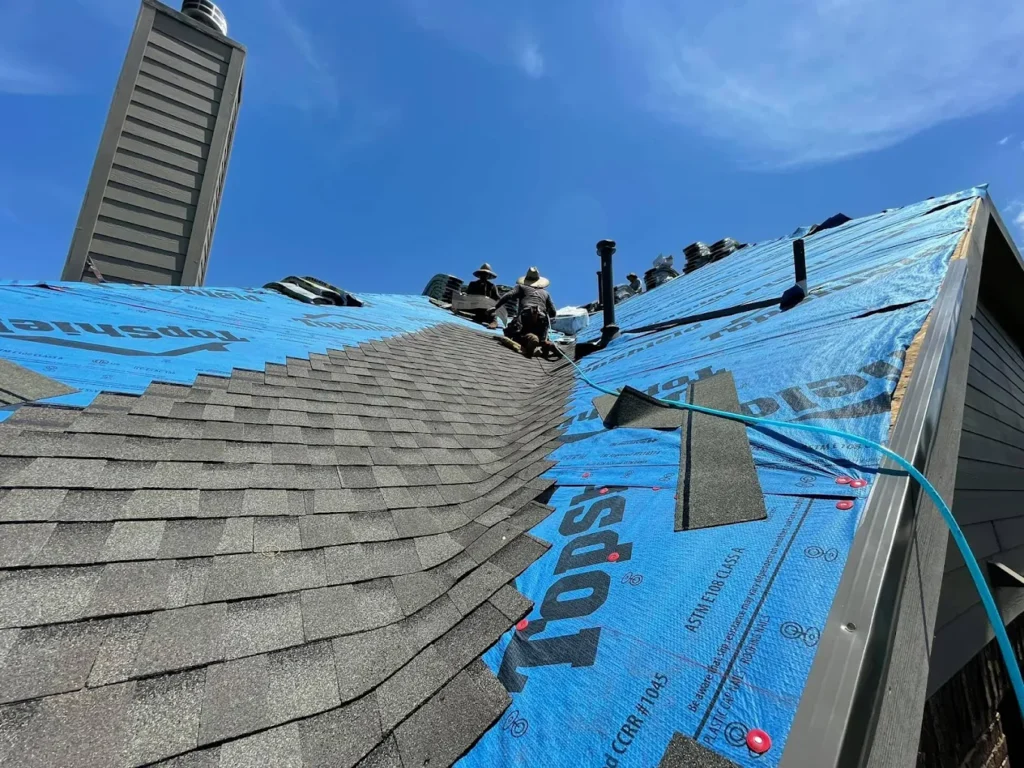
Shingle Weight Calculations: 10, 20, 30, 40 & 50 Bundles
This is where bundle weight becomes practically useful. The formula is trivially simple:
Total weight = Number of bundles × Weight per bundle
Quick reference table (standard asphalt shingles)
| Number of Bundles | 3-Tab (45–60 lbs each) | Architectural (60–80 lbs each) |
| 5 bundles | 225–300 lbs | 300–400 lbs |
| 10 bundles | 450–600 lbs | 600–800 lbs |
| 15 bundles | 675–900 lbs | 900–1,200 lbs |
| 20 bundles | 900–1,200 lbs | 1,200–1,600 lbs |
| 25 bundles | 1,125–1,500 lbs | 1,500–2,000 lbs |
| 30 bundles | 1,350–1,800 lbs | 1,800–2,400 lbs |
| 40 bundles | 1,800–2,400 lbs | 2,400–3,200 lbs |
| 50 bundles | 2,250–3,000 lbs | 3,000–4,000 lbs |
Real-world context for each quantity
- 10 bundles (~1 square of material plus waste): A single rooftop trip’s worth of material for a small repair. One strong person with a good ladder technique might move this; most people shouldn’t.
- 20–30 bundles (~2–3 squares): A shed, garage, or small porch roof. Now you’re thinking about truck payload and trailer capacity.
- 40–50 bundles (~4–5 squares): A small house section or large patio cover. A half-ton pickup’s payload rating (typically 1,500–2,300 lbs) is already exceeded by architectural bundles at this count , this is where delivery becomes the sensible option.
- 60–80 bundles (~a full average roof): Delivery by the supplier is effectively mandatory, and the shipment will arrive on one or two pallets.
Calculating weight from a single shingle
If you have one loose shingle and a scale, you can work backwards:
Single shingle weight × shingles per bundle = bundle weight
Bundle weight × bundles per square = weight per square
Weight per square × number of squares = total roof weight
Example: A 3-tab shingle weighs 2.0 lbs. A bundle holds 26 shingles → 52 lbs per bundle. Three bundles per square → 156 lbs per square. A 20-square roof → 3,120 lbs of shingle material.
How Much Does an Entire Roof’s Shingles Weigh?
Here’s the complete calculation chain, start to finish, for a typical home:
Step-by-Step: Full Calculation
Find your roof area.
Get the actual roof measurement (from a satellite measurement report, your contractor, or careful tape-and-math), not your home’s floor plan. For a rough estimate, multiply the footprint by a pitch factor:
| Roof Pitch | Approx. Multiplier |
| Flat to 4:12 | 1.00–1.06 |
| 5:12 to 7:12 | 1.08–1.16 |
| 8:12 to 10:12 | 1.20–1.30 |
| 11:12 and steeper | 1.30–1.42 |
Convert to squares.
Roof sq ft ÷ 100 = squares.
Convert to bundles.
Squares × 3 = bundles (standard asphalt).
Multiply by bundle weight.
Bundles × weight per bundle = total shingle weight.
Worked example: a 2,000 sq ft home
- Footprint: 2,000 sq ft, 6:12 pitch → roof area ≈ 2,000 × 1.12 = 2,240 sq ft
- Squares: 2,240 ÷ 100 = 22.4 squares
- Bundles: 22.4 × 3 = 67 bundles (plus ~10% waste → order ~74)
- Total weight at 70 lbs/bundle: 74 × 70 = ~5,180 lbs of shingles
That’s roughly 2.5 tons of shingle material going onto , and eventually coming off of , an average American roof.
What this means structurally
Standard asphalt shingle roofs are well within the design capacity of virtually any code-built residential structure (asphalt systems typically total 2–4 lbs per sq ft, including underlayment). Weight only becomes a structural concern when switching to slate, tile, or when stacking multiple layers. Building codes generally prohibit more than two layers of roofing, and most professionals recommend a full tear-off rather than layering , partly for weight, partly because layered roofs hide deck problems.
How Much Does a Pallet of Shingles Weigh?
A standard shingle pallet holds 42 bundles , enough to cover approximately 14 roofing squares (1,400 sq ft) of roof.
| Pallet Contents | Calculation | Total Weight |
| 42 bundles, 3-tab (45–60 lbs) | 42 × 45–60 | 1,890–2,520 lbs |
| 42 bundles, architectural (60–80 lbs) | 42 × 60–80 | 2,520–3,360 lbs |
| 42 bundles, premium (80–100+ lbs) | 42 × 80–100 | 3,360–4,200+ lbs |
Add roughly 40–60 lbs for the pallet itself and packaging wrap. In practical terms, a full pallet of architectural shingles weighs about as much as a small car , which is why shingle delivery involves flatbed trucks, and why the pallet is placed once, deliberately, and not moved again by hand.
How many pallets does a typical roof need?
| Roof Size | Squares | Bundles | Pallets (42 bundles each) |
| 1,400 sq ft | 14 | ~46 | 1 |
| 2,000 sq ft | 20 | ~66 | 1.5–2 |
| 2,400 sq ft | 24 | ~79 | 2 |
| 3,000 sq ft | 30 | ~99 | 2.5–3 |
How to Find the Exact Weight of Your Specific Shingles
Ranges are for planning. When accuracy matters , a structural question, a debris estimate, a delivery calculation , go to the source:
- The product packaging. Every bundle carries a label stating coverage per bundle, pieces per bundle, and often weight. This is the fastest authoritative answer.
- The manufacturer’s specification sheet (spec sheet). Every major manufacturer (GAF, Owens Corning, CertainTeed, IKO, Atlas, Malarkey) publishes PDF spec sheets for each product line, listing bundles per square, pieces per square, dimensions, and sometimes shipping weight. Search: “[brand] [product name] spec sheet PDF.”
- The retailer listing. Home Depot, Lowe’s, and building-supply listings frequently list “Weight Per Bundle” in the product specifications section.
- Your contractor’s estimate. Professional estimates specify the exact product, which pins down all packaging numbers.
One warning about third-party numbers: even manufacturer shipping weights can differ slightly from in-hand scale weight due to moisture, granule variance, and packaging. For critical calculations (structural engineering, dumpster tonnage limits), build in a 5–10% margin rather than trusting any figure to the pound.
What Shingle Weight Means for Your Roofing Project
Understanding shingle weight pays off in four practical ways:
Delivery and logistics
Knowing that your roof needs ~74 bundles at ~70 lbs each tells you immediately that (a) you need supplier delivery, not pickup-truck trips, and (b) you need to plan where the pallet gets dropped , driveway access, ground protection, and proximity to the work face all matter.
Tear-off and disposal
If you’re replacing a roof, the debris coming off weighs roughly what the new material weighs in , for each existing layer. A 22-square tear-off of architectural shingles produces approximately 4,000–5,300 lbs of debris per layer. Dumpster sizing and disposal tonnage fees are calculated on exactly these numbers, and multi-layer roofs multiply them.
Material verification
When your delivery arrives, a quick sanity check , counting bundles and spot-weighing one , confirms you received what you paid for. It’s rare, but short-counts and mis-picks happen.
Making the “which shingle should I choose?” decision
Weight sits at the center of the 3-tab vs. architectural decision: the heavier product costs more and demands more of your structure and installers, but delivers 10+ extra years of service life, substantially better wind ratings, and a dimensional look that flat 3-tab shingles can’t match. Weight isn’t the only consideration , warranty, algae resistance, impact class, and installer certification all matter , but it’s the physical foundation the rest is built on.
Planning a roofing project? Once you know how much material your roof involves, the natural next question is what it will cost. Our Roofing Cost Calculator lets you turn your roof size into a realistic budget range in a few minutes , no email required, no sales call triggered.
And if you’ve moved from research to actually considering a new shingle roof, our Shingle Roofing service covers the products we install, our installation process, and what a professional replacement looks like from estimate to final inspection.

Shingle Weight in Central Texas: Hail, Heat & What to Consider
Shingle weight interacts with local climate in ways that matter specifically for Austin and Central Texas homeowners:
- Hail. Central Texas sits in one of the most hail-active corridors in the country. This is where the weight conversation connects to Class 4 impact-resistant shingles: they’re among the heaviest architectural products (typically 65–85 lbs per bundle) because the added polymer-modified asphalt and thicker construction are exactly what absorbs hail impact. Many insurers offer premium discounts for Class 4 roofs , in a hail-prone region, the heavier shingle can literally pay for part of itself.
- Heat. Austin’s sustained 100°F+ summers accelerate asphalt aging via thermal cycling. Heavier, premium laminated shingles with more asphalt content generally hold up better to UV and thermal stress than thin 3-tab products , another reason the region has overwhelmingly shifted to architectural shingles.
- Storm season logistics. When a hail event hits the Austin metro, material demand spikes and supplier lead times stretch. Knowing your bundle and pallet counts in advance , rather than starting the math after your roof is damaged , helps you evaluate contractor estimates faster and spot material-padding.
If your roof took hail damage recently, the weight math above is the same one your adjuster and contractor are using to scope tear-off and replacement.
Conclusion
A bundle of asphalt shingles weighs 45–80 pounds in the vast majority of cases , 45–60 lbs for 3-tab, 60–80 lbs for architectural , with premium products running heavier and sometimes packaged at more than 3 bundles per square. Those ranges convert simply: roughly 135–240 lbs per roofing square, roughly 5,000 lbs of shingle material on an average home, and roughly 2,500–3,400 lbs per delivery pallet.
The number that matters for your project is the one on your specific product’s spec sheet , everything else is planning math. And the single most important habit this article can leave you with: measure your roof, not your house, before you convert anything.
Frequently Asked Questions
How much does a bundle of shingles weigh, exactly?
Most asphalt shingle bundles weigh between 45 and 80 pounds: 45–60 lbs for 3-tab and 60–80 lbs for architectural shingles. Premium and designer products can exceed 80 lbs, and specialty products can require 4–5 bundles per square instead of the standard 3. The exact figure for your product is on the bundle label or the manufacturer’s spec sheet.
Can one person carry a bundle of shingles?
Most healthy adults can carry a single standard bundle (45–80 lbs) short distances on flat ground. Carrying bundles up ladders, onto roofs, or repeatedly over a workday is where injuries happen , professional roofers stage materials and use lifts for a reason. If you’re DIY-ing, plan for ground-level staging and never carry bundles up a ladder one-handed.
How much do 20 bundles of shingles weigh?
For standard asphalt shingles: 900–1,200 lbs (3-tab) or 1,200–1,600 lbs (architectural). That’s beyond the safe payload of most half-ton pickups for anything but the shortest, slowest trip , and beyond common sense for most DIY transport.
How many bundles of shingles are in a square?
Three, for standard 3-tab and architectural asphalt shingles (each bundle covers ~33.3 sq ft). Specialty and premium products may require 4 or 5 bundles per square , always check the specific product’s packaging.
How much does a square of shingles weigh?
135–180 lbs for 3-tab shingles and 180–240 lbs for architectural shingles (3 bundles × bundle weight). Premium products run 320–500+ lbs per square.
How much does a pallet of shingles weigh?
A standard pallet holds 42 bundles (~14 squares): approximately 1,890–2,520 lbs of 3-tab shingles or 2,520–3,360 lbs of architectural shingles, plus the pallet itself.
How much does a single shingle weigh?
Roughly 2–4 lbs for an asphalt shingle, depending on type (3-tab on the low end, laminated architectural on the high end). Cedar shingles run 2–4 lbs each; slate shingles can weigh 8–12 lbs each.
How many bundles do I need for a 2,000 sq ft house?
First, remember your roof area is larger than your floor plan , typically 2,200–2,800 sq ft for a 2,000 sq ft home depending on pitch and overhangs. At ~24 squares and 3 bundles per square plus 10% waste, plan on roughly 79 bundles (~5,500 lbs of material). Get an actual roof measurement before ordering.
Does heavier mean better when it comes to shingles?
Mostly, within the same category , extra weight usually means more asphalt and a thicker mat, which correlates with durability. But weight alone isn’t a quality metric: some premium products achieve high performance with advanced materials at moderate weights, and an old, moisture-laden shingle is heavy without being good. Evaluate shingles on warranty, wind and impact ratings, and manufacturer reputation alongside weight.
How much will my old roof weigh when torn off?
Approximately the same as the new material going on, per layer: 180–240 lbs per square per layer for architectural shingles, 135–180 lbs for 3-tab. A 22-square, two-layer tear-off produces roughly 8,000–10,500 lbs of debris , a number your dumpster size and disposal fees should be based on.