Skip to content

If you own or manage a commercial building in Austin, your roof works harder than almost any other part of the property. Between 100-degree summers that bake rooftop surfaces, hailstorms that roll through the Hill Country, high winds, and the occasional flash flood, a commercial roof in Central Texas has to do a lot more than just keep water out.
The problem is that most commercial roofing advice online is written for a generic national audience. What works on a warehouse in Ohio or a retail center in Seattle is not necessarily the right call for an office building off Mopac or a restaurant in Round Rock. The right system depends on your building’s slope, how much foot traffic the roof gets, whether you have rooftop HVAC units or grease exhaust, your energy goals, and – most importantly – how the system handles Texas weather.
We’ve been installing and repairing commercial roofs across Austin and Central Texas for over 20 years. Here’s an honest breakdown of every major commercial roofing system, what it costs, how long it lasts, and which Austin buildings each one actually makes sense for.
First Things First: Flat Roofs vs. Low-Slope vs. Steep-Slope Commercial Roofs
Before comparing materials, it helps to understand the three roof geometries you’ll see on Austin commercial buildings.
Flat Roofs (Low-Slope)
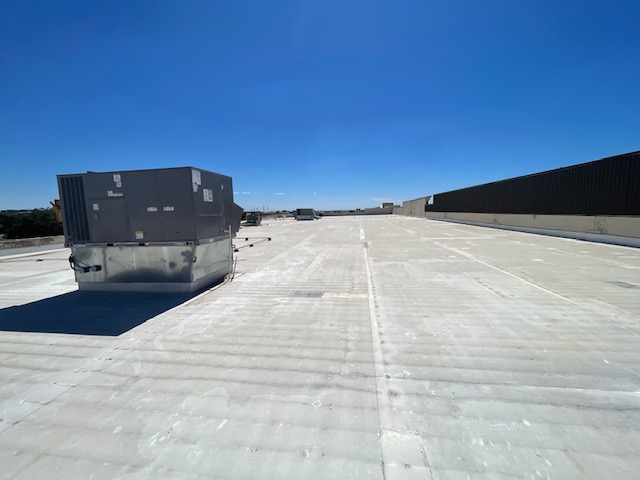
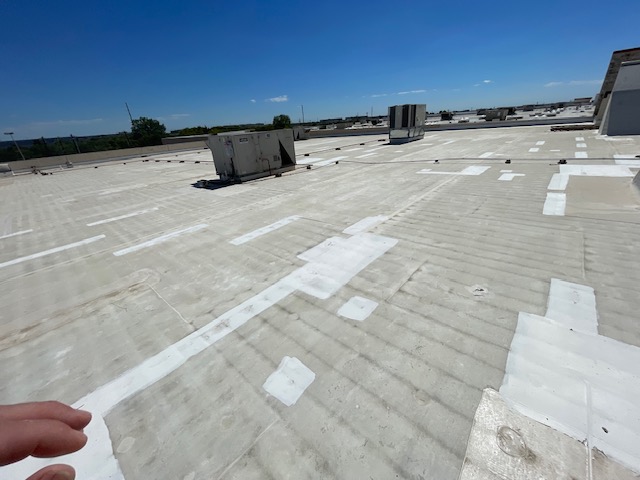
Despite the name, no commercial roof is truly flat. Every commercial roof is built with a slight slope – typically between 1/4 inch and 1/2 inch of drop per foot – to move water toward drains and scuppers. To the eye, these roofs look flat, which is why the terms “flat roof” and “low-slope roof” are used interchangeably.
Why Austin commercial buildings use them:
- Maximized interior space – no pitched attic, more usable square footage
- Rooftop equipment placement – HVAC units, solar arrays, and exhaust systems sit on the roof out of sight
- Lower installation cost – fewer materials and faster installation than pitched systems
- Easier maintenance access – inspections and repairs are safer and cheaper
The tradeoff: Water drainage. On a low-slope roof, water doesn’t run off quickly – it sits, pools, and tests every seam and penetration. That’s why the membrane you choose and the quality of installation matter so much more on a flat roof than on a pitched one. In Austin, where a single thunderstorm can dump several inches of rain in an hour, drainage design is not a detail. It’s the whole game.
Steep-Slope Commercial Roofs
Some commercial buildings – churches, schools, municipal buildings, and multi-family communities designed to look residential – use pitched roofs with standard slopes (more than 4 inches of rise per 12 inches of run). These use gravity to shed water fast and typically use shingles, tile, or standing seam metal. They’re more expensive to install but last longer and rarely have pooling issues.
Quick rule of thumb: Warehouses, retail centers, offices, and restaurants in Austin almost always use low-slope systems. Churches, schools, and residential-style multi-family almost always use steep-slope systems.
TPO (Thermoplastic Olefin)
TPO is the most commonly installed commercial roofing membrane in the United States today, and it’s especially popular across Texas – for good reason.
What It Is
TPO is a single-ply membrane made from a blend of polypropylene and ethylene-propylene rubber. It’s manufactured in large rolls, typically white or light gray, and installed in a single layer over insulation.
How It’s Installed
TPO membranes are attached to the roof deck with mechanical fasteners or adhesive, and the seams between rolls are heat-welded with a hot-air welder. A properly welded seam fuses the two sheets into a single continuous membrane – stronger than the material itself. This is a major durability advantage over adhesive-taped systems.
Why TPO Works So Well in Austin
- Reflects the Texas sun. White TPO reflects UV radiation instead of absorbing it, which can noticeably lower rooftop surface temperatures and reduce cooling loads in buildings where the AC runs eight months a year.
- Heat-welded seams hold up against wind-driven rain, which matters in Austin’s severe storm seasons.
- Puncture and tear resistance is good, handling routine foot traffic from HVAC maintenance.
- Cost-effective. TPO typically costs less than PVC while delivering similar reflectivity.
The Honest Downsides
- Lifespan varies by manufacturer. Quality TPO lasts 20-30 years; cheaper formulations have had shrinkage and seam issues in the past. The brand and installer matter.
- Not the best choice around grease. If your building is a restaurant with kitchen exhaust venting onto the roof, TPO degrades faster where grease deposits accumulate.
Best For
Office buildings, retail centers, warehouses, medical facilities, and apartment communities with large, mostly open roof decks – especially owners focused on energy efficiency.
EPDM (Ethylene Propylene Diene Monomer)
EPDM is a synthetic rubber membrane with one of the longest track records in the industry – it’s been protecting commercial roofs for over 60 years, and some of the earliest installations are still performing.
What It Is
EPDM is a rubber sheet made primarily from ethylene and propylene. It comes in black (the classic) or white, in thicknesses from 45 to 90 mil, and in very wide sheets – up to 50 feet – which means fewer seams on large roofs.
How It’s Installed
EPDM can be fully adhered with bonding adhesive, mechanically fastened, or ballasted with stone. Seams are sealed with liquid adhesive or seam tape rather than heat-welded.
The Strengths
- Longevity. A properly installed and maintained EPDM roof routinely lasts 30-40+ years – often the longest service life of any single-ply membrane.
- Outstanding weather resistance. EPDM shrugs off UV, ozone, temperature swings, and hail impact better than almost any alternative. It’s flexible in the cold and stable in the heat.
- Fewer seams on large buildings thanks to wide sheets, which means fewer potential leak points.
- Easy, inexpensive repairs. Patches are simple and the material tolerates neglect better than thermoplastics.
The Honest Downsides
- Black EPDM absorbs heat. In an Austin summer, a black rubber roof can hit extreme surface temperatures, transferring heat into the building and driving up cooling costs. White EPDM exists, but it costs more and its track record is shorter.
- Seam tape and adhesive age. Adhesive-based seams are the classic failure point – they degrade over 15-20 years and are more vulnerable to wind-driven rain than welded seams.
- Aesthetics. Some owners simply don’t like the look of black rubber on a visible roof.
Best For
Large industrial buildings, warehouses, and properties where long-term durability matters more than reflectivity – especially owners planning to hold the building for decades. Ask about white EPDM if energy efficiency is a priority.
PVC (Polyvinyl Chloride)
PVC is the premium single-ply option – and the one we recommend most often when a building has chemical exposure on the roof.
What It Is
PVC is a thermoplastic membrane with two layers of polyvinyl chloride reinforced with a polyester scrim in between. It’s almost always white, highly reflective, and has been used on commercial buildings since the 1960s.
How It’s Installed
Like TPO, PVC is installed in rolls and heat-welded at the seams, producing a continuous, watertight surface. It can be mechanically fastened, fully adhered, or installed as a fleece-backed system over existing roofs (useful for retrofit projects).
The Strengths
- Best-in-class chemical resistance. PVC is unaffected by grease, oils, and many industrial chemicals. If you operate a restaurant, commercial kitchen, food processing facility, or any building with chemical exhaust on the roof, PVC is the industry-standard recommendation.
- Superior seam strength. Heat-welded PVC seams are among the strongest in roofing and deliver excellent wind uplift resistance.
- Fire resistance. PVC is naturally fire-retardant, which is why it’s often specified on buildings with stricter fire code requirements.
- Highly reflective for energy efficiency in Austin’s heat.
- Long service life – 20-30 years with routine maintenance.
The Honest Downsides
- Higher upfront cost than TPO or EPDM – typically the most expensive single-ply option.
- Environmental considerations. PVC contains chlorine, and some sustainability programs prefer TPO or EPDM.
- Older formulations had issues with plasticizer migration (the membrane getting brittle over time), though modern formulations have improved significantly.
Best For
Restaurants, grocery stores, hotels, and industrial facilities – any Austin commercial building where grease, oil, or chemical exposure makes TPO a risky choice. For buildings without chemical exposure, TPO usually delivers 90% of the performance at a lower price.
Modified Bitumen (Mod Bit)
Modified bitumen is the modern evolution of built-up roofing – an asphalt-based system that’s been a commercial workhorse for over 50 years.
What It Is
Mod bit membranes are asphalt modified with polymers (SBS rubber or APP plastic) and reinforced with fiberglass or polyester. The two types:
- SBS (Styrene-Butadiene-Styrene): stays flexible in temperature swings – the better choice for most Central Texas applications
- APP (Atactic Polypropylene): more UV and heat resistant, applied by torch
How It’s Installed
The mod bit is installed in two plies (layers), creating roughly 240 mils of total membrane thickness – about four times thicker than a 60-mil single-ply system. Installation methods include torch-applied (an open flame bonds the layers), cold-applied adhesive, and self-adhered peel-and-stick.
The Strengths
- Redundant waterproofing. Two plies mean that if the top layer is damaged, there’s a second full layer underneath. This is a genuine advantage on roofs with heavy foot traffic.
- Handles complex details well. Parapets, walls, and penetrations are easier to flash with mod bits than with single-ply membranes.
- Decades of proven performance in Texas commercial construction.
- Straightforward repairs – any roofer can patch mod bits.
The Honest Downsides
- The dark surface absorbs heat. Most mod bits are black, which raises rooftop temperatures and cooling costs in Austin summers. Lighter coatings are available but add cost.
- Shorter lifespan than single-ply systems – typically 15-25 years.
- Torch application requires real expertise. An inexperienced crew with an open flame on your roof is a fire risk. This is not the system to hire the cheapest bidder for.
- Weight. Multi-ply systems are heavier, which matters on older structures with limited load capacity.
Best For
Smaller commercial roofs, roofs with lots of equipment and penetrations, buildings where foot traffic is heavy (service corridors, maintenance routes), and owners who value repairability over maximum lifespan.
Built-Up Roofing (BUR)
BUR is the original flat roof system – alternating layers of asphalt and reinforcing fabric, topped with gravel or a mineral surface. It’s been around for over a century, and while it’s less common on new Austin construction, it still appears on older buildings and some specific applications.
Strengths: Excellent waterproofing redundancy (3-4+ plies), great UV protection from the gravel surface, and outstanding fire resistance.
Weaknesses: Heavy (can require structural reinforcement), expensive labor, difficult leak detection under gravel, and declining contractor familiarity – fewer crews in Austin install BUR well today.
Best For: Historic building restorations and situations where matching an existing BUR system matters. For most new Austin commercial roofs, a modern single-ply or mod bit system is a better value.
Commercial Metal Roofing
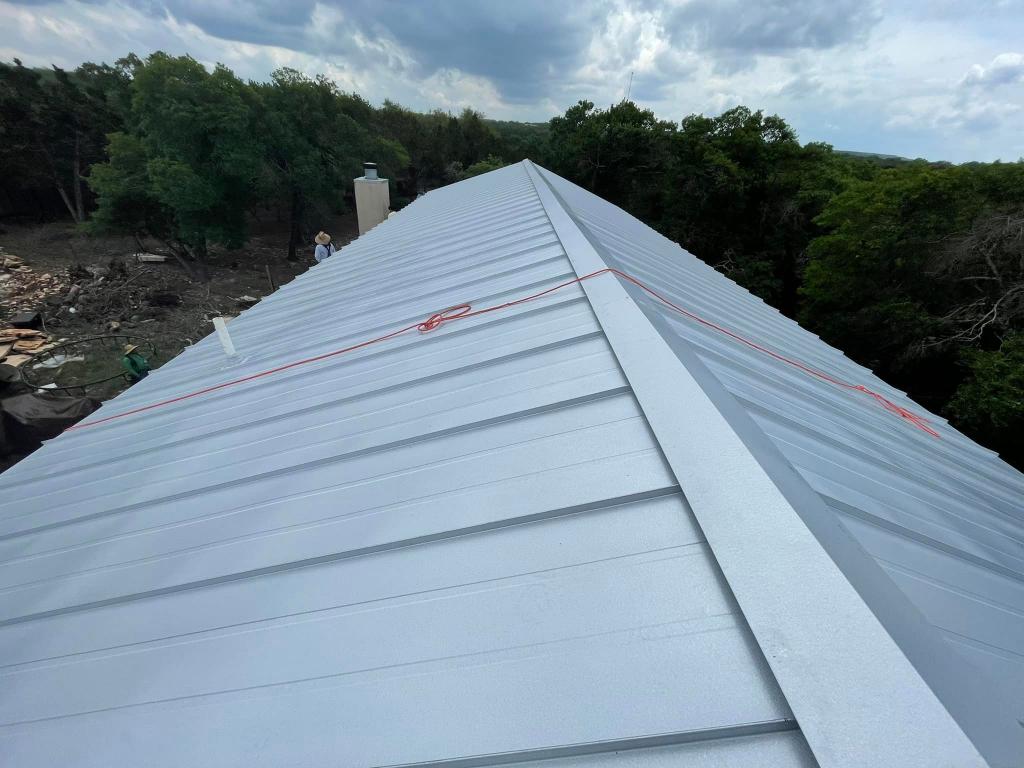
Metal isn’t just for pitched roofs. Standing seam metal panels are an increasingly popular choice on low-slope commercial applications in Central Texas, and for good reason.
Why Metal Makes Sense in Austin
- Longevity. A standing seam metal roof lasts 40-70 years – two to three times the lifespan of most flat membrane systems.
- Hail performance. Metal is one of the most hail-resistant roofing materials available, which matters in a city that sits in one of the most hail-prone corridors in the country.
- Heat reflection. Painted metal with reflective coatings (cool-roof rated colors) significantly reduces heat gain.
- Wind resistance. Properly installed standing seam systems handle high wind loads better than any membrane.
- Low maintenance. No seams to re-tape, no gravel to redistribute.
The Honest Downsides
- Higher upfront cost – typically the most expensive commercial option per square foot.
- Oil canning (visible waviness in flat panels) can bother some owners, though proper panel design and installation minimize it.
- Noise during rain and hail on buildings where the underside of the deck is exposed – usually a non-issue on insulated commercial buildings.
Quick Comparison: Which System Fits Your Austin Building?
| System | Typical Lifespan | Upfront Cost | Heat Reflectivity | Chemical Resistance | Best Building Type |
|---|---|---|---|---|---|
| TPO | 20-30 yrs | $$ | Excellent (white) | Fair | Offices, retail, warehouses, medical |
| EPDM | 30-40+ yrs | $-$$ | Poor (black) / Good (white) | Good | Warehouses, industrial, long-term holds |
| PVC | 20-30 yrs | $$$ | Excellent | Excellent | Restaurants, kitchens, industrial |
| Mod Bit | 15-25 yrs | $$ | Poor (dark) | Good | Small roofs, high foot traffic, complex details |
| BUR | 20-30 yrs | $$$ | Poor | Good | Historic, matching existing systems |
| Metal | 40-70 yrs | $$$$ | Good-Excellent | Good | Long-term holds, hail-prone areas, industrial |
Lifespans assume quality materials and proper installation in Central Texas conditions.
How to Choose the Right Commercial Roofing System in Austin
With the systems compared, here’s how the decision usually comes together for Central Texas buildings:
1. Start with your building’s slope and structure. Flat or low-slope means single-ply, mod bit, BUR, or low-slope metal. Pitched means shingles, tile, or standing seam. Your roof’s load capacity may also rule heavier systems in or out.
2. Factor in Austin’s climate – honestly. Any system you choose has to handle 100-degree+ surface temperatures for months, hail events, and intense storm rain. Reflective white membranes (TPO, PVC, white EPDM) pay real dividends on Austin energy bills. If hail exposure is your top concern, metal or a thick EPDM deserves a close look.
3. Match the membrane to your building’s use. Restaurant or kitchen exhaust? PVC. Heavy HVAC traffic? Mod bit or TPO. Large open warehouse roof? TPO or EPDM. There’s no single “best” system – there’s a best system for your building.
4. Think in lifecycle cost, not just price. A cheaper system that needs replacement in 15 years is usually more expensive over 30 years than a premium system that lasts 40. Factor maintenance, repairs, energy costs, and potential disruption to your tenants.
5. Choose your installer as carefully as your membrane. More commercial roofs fail from poor installation than from material defects. Welded seams, flashing details, and drainage design are where a good roof is won or lost. Ask any contractor about manufacturer certifications, local commercial references, and warranty terms – in writing.
Conclusion for Austin Commercial Property Owners
There’s no universal winner among commercial roofing systems – but there is a right answer for your specific building, and it usually comes down to slope, use, budget, and how the system handles Central Texas weather over a 20-30 year horizon. A white TPO roof on a Round Rock office building, a PVC membrane on a South Austin restaurant, and a standing seam metal roof on a Dripping Springs industrial facility are all correct answers to different questions.
At Altitude Roofing, we’ve helped Austin-area commercial property owners, property managers, and facility directors sort through exactly these decisions for over two decades. As a GAF Master Elite certified contractor – a certification held by only the top 2% of roofers nationwide – we bring manufacturer-backed warranties and honest, no-pressure guidance to every commercial project, from inspections and repairs to full system replacements.
Not sure which system your building needs? Schedule a free commercial roof evaluation. We’ll assess your current roof, walk you through your options in plain language, and give you a straightforward recommendation.
Frequently Asked Questions
Is TPO or EPDM better for a commercial roof in Austin?
It depends on your priorities. TPO (white) reflects heat and has welded seams, making it the more common choice for Austin buildings focused on cooling costs. EPDM lasts longer and handles hail and temperature extremes better, but standard black EPDM absorbs heat. If longevity is your top concern, ask about white EPDM as a middle ground.
What is the longest-lasting commercial roofing system?
Standing seam metal (40-70 years) and EPDM (30-40+ years) lead the field for service life. Modified bitumen and TPO typically fall in the 15-30 year range depending on quality and maintenance. Actual lifespan depends heavily on installation quality, drainage design, and how well the roof is maintained – in any system.
Which commercial roof is best for a restaurant in Austin?
PVC, in most cases. Kitchen grease and exhaust degrade TPO and EPDM over time, while PVC is specifically formulated to resist chemical exposure. It’s why PVC is the industry-standard specification for restaurants, grocery stores, and food service buildings.
Can you install a new commercial roof over an existing one?
Sometimes. “Retrofit” or overlay installations are possible when there’s only one existing layer, the deck is in good condition, and local code allows it. It can save significantly on tear-off costs. The only way to know for sure is a professional inspection of the existing roof and deck.
How much does a commercial roof replacement cost in Austin?
Costs vary widely based on system type, roof size, tear-off requirements, insulation, and penetrations. Single-ply membrane systems are generally the most cost-effective per square foot, while metal is the premium option. We provide detailed, itemized written estimates after a free on-site inspection – no ballpark numbers over the phone.
Does Altitude Roofing handle commercial insurance claims?
Yes. We work with most insurance companies and can walk you through the claims process for storm or hail damage. Our team follows HAAG engineering inspection protocols – the same standard insurance companies use – so our documentation carries weight with adjusters.