Skip to content
After a Central Texas storm rolls through, most homeowners ask the same question. Do I fix what’s damaged – or is it time to start fresh? The answer isn’t always obvious. And making the wrong call can cost you thousands of dollars, either in unnecessary replacement costs or in repeated repairs on a roof that was already past its prime.
This guide walks you through every factor that matters. Roof repair vs roof replacement comes down to roof age, damage type, real costs, insurance coverage, and your long-term plans for the home. By the end, you’ll know exactly which direction makes sense for your situation.
What Austin’s Climate Does to Your Roof
Central Texas is tough on roofs. Most homeowners don’t realize just how much tougher it is here compared to cooler states. The UV index in Austin runs significantly higher than the national average. That alone degrades shingles faster than the label on the package suggests.
Add in the hailstorms. Austin experiences multiple hail events every single year. Some are minor. Others leave dents on gutters, cracks in shingles, and impact damage that doesn’t show up from the ground. Then there are the temperature swings – cold winters followed by brutal summers – that cause roofing materials to expand, contract, crack, and separate.
Standard asphalt shingles are rated for 25 to 30 years. But in Austin, many roofs show significant wear by year 15 to 20. That gap matters when you’re weighing repair against replacement.
The Factors That Actually Drive the Decision
Roof Age: The Number That Matters Most
No single factor matters more than how old your roof is. A 7-year-old roof with a few missing shingles is almost always a repair. A 17-year-old roof showing the same damage is a different conversation entirely.
For Austin homeowners, a practical benchmark is 15 years. Before that, targeted repairs typically make sense if the damage is localized. After that, you’re patching a roof that’s already approaching the end of its useful life in this climate. Metal roofs are the exception – they can last 40 to 70 years with proper care.
If your roof is past 15 years old and you’re calling for repairs regularly, that pattern is telling you something.
How Much of the Roof Is Actually Damaged
Location and spread matter just as much as severity. A single slope with wind damage is very different from hail that hit all four sides of your home.
Localized damage – a few cracked shingles, a failed flashing seal around a chimney – points toward repair. Widespread damage that crosses multiple slopes or affects the ridge and valleys points toward replacement. Structural damage underneath the surface, like soft decking or sagging sections, often means a full residential roof replacement is the better long-term solution.
The 50% Rule – And Why It Exists
Most roofing professionals and insurance adjusters use a simple benchmark: if the cost of repair exceeds 50% of a full replacement, replace the roof. The logic holds up. You’re spending near-replacement money on a roof that still has all its age-related vulnerabilities. You get the expense without getting the reset.
This rule also shows up in insurance contexts. Adjusters often use similar thresholds when determining whether a claim warrants repair or full replacement. Knowing this going in helps you have a more informed conversation with your contractor and your insurer.
How Many Times Has It Been Repaired?
One repair in five years is normal. Three or more repairs in that same window is a pattern – and not a good one. Repeated fixes on the same roof usually mean the underlying system is failing, not just isolated spots.
Signs You Can Repair Your Roof
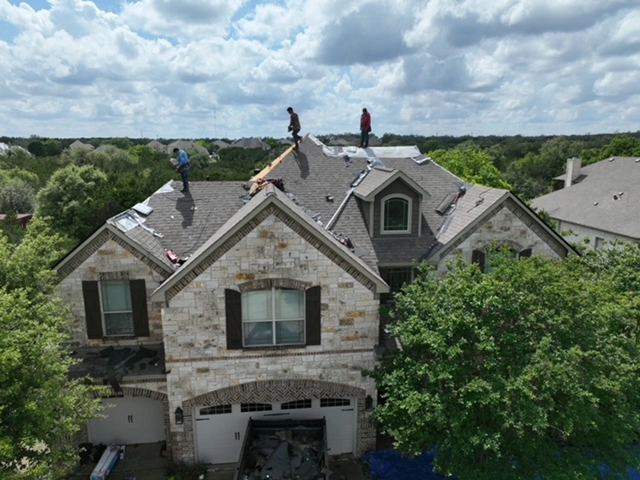
Sometimes a repair is genuinely the right answer. Here’s when it makes sense:
- Damage is limited to one area or slope, not the whole roof
- The roof is under 12 to 15 years old with sound decking underneath
- The repair cost is well under 50% of full replacement value
- This is the first or second repair in the roof’s lifetime
A repair under $1,500 to $2,500 on a roof that’s otherwise in good condition is a solid investment. It extends your roof’s life without the cost of a full replacement. The key word there is otherwise – the rest of the roof needs to be healthy for the repair to make long-term sense.
Signs You Need a Roof Replacement
The Roof Is 15+ Years Old in Central Texas
Age combined with Central Texas conditions is often enough on its own. At 15 years, most asphalt roofs in Austin have already dealt with thousands of UV hours, multiple hailstorms, and years of heat cycling. The shingles may still look passable from the driveway. But up close, granule loss, micro-cracking, and brittleness tell a different story.
A roof at this stage doesn’t have the flexibility or protective capacity it once had. Repairing it is like replacing the tires on a car that needs a new engine.
Widespread Hail or Storm Damage
Hail doesn’t just damage the spots you can see. A significant storm typically affects the entire roof surface. Insurance adjusters inspect all slopes, not just the visible damage on the front. If your whole roof took a hit, a repair on one section doesn’t restore what you lost.
Furthermore, if you have an RCV (Replacement Cost Value) policy, a full replacement covered by insurance may cost you nothing beyond your deductible. In that scenario, choosing a repair means leaving money on the table.
Sagging, Soft Spots, or Deck Damage
This is the most serious sign. Sagging means structural damage – water has likely been getting into the decking for a long time. No surface-level repair solves that. Replacement is the only option that addresses the problem at its source.
Walk to your attic after a heavy rain. If you see light coming through, moisture staining, or soft areas when you press on the decking from below, the damage goes deeper than the shingles.
Your Energy Bills Keep Climbing
This one surprises a lot of homeowners. A failing roof loses its insulation value. Air conditioning in Austin is not optional – and if your cooling costs have gone up without any other explanation, your roof may be why.
Replacing with impact-resistant or energy-efficient shingles can make a real difference in summer utility bills. That energy savings is part of the long-term financial case for replacement, not just protection from leaks.
Persistent Leaks After Repairs
If a leak comes back within 12 to 18 months of being fixed, the repair addresses the symptom but not the cause. Recurring leaks mean water is finding its way in through systemic failure – not a single weak point. At that stage, you’re chasing a problem that will keep moving.
Real Cost Numbers for Austin Homeowners
Competitors often talk about cost in vague terms. Here’s what the actual numbers look like in Central Texas right now.
Roof repairs in Austin typically run:
- Minor work (a few shingles, flashing seal): $200–$800
- Moderate repairs (valley, chimney, small section): $800–$2,500
- Major repairs (large section, some decking): $2,500–$5,000+
Full roof replacements in Austin typically run:
- Standard asphalt (architectural shingles): $10,000–$16,000
- Premium impact-resistant shingles: $14,000–$20,000+
- Metal roof replacement: $18,000–$35,000+
Here’s the math that matters. A $3,500 repair on a 17-year-old roof may buy you two or three more years. A $13,000 replacement gives you 20-plus years with a full manufacturer warranty. Divide the cost by the years of protection and replacement often wins – especially when insurance covers a significant portion. Here’s our detailed guide on roof replacement cost in Austin.
How Insurance Changes the Entire Equation
This is where roof repair vs roof replacement decisions get more nuanced for Austin homeowners. When storm damage is involved, your insurance policy may cover most or all of a full replacement. That fundamentally shifts the math.
First, know your policy type. An ACV (Actual Cash Value) policy pays the depreciated value of your roof – meaning a 15-year-old roof gets paid out as a 15-year-old roof, not a new one. An RCV (Replacement Cost Value) policy pays the full cost to replace materials. The gap between those two can be several thousand dollars.
Second, bring a qualified contractor to the adjuster inspection. Hail damage isn’t always obvious to an untrained eye. A contractor who understands insurance documentation can make sure all legitimate damage is included in the claim scope – not just the obvious spots. At Altitude Roofing, our owner holds an all-lines insurance adjuster license. We are the number one roofing contractor in Austin tx. That means we speak both languages – roofing and insurance – and we make sure nothing gets missed.
What About a Partial Re-Roof?
Most homeowners don’t know this option exists. A partial re-roof means replacing one or two slopes instead of the whole surface. It makes sense in specific situations – when hail damage was directional and concentrated on one side, when one slope is significantly older due to prior repairs, or when the budget genuinely can’t stretch to a full replacement.
However, it has real limitations. Material matching is difficult on older roofs. The replaced slopes will look different from the original ones. And most manufacturer warranties apply to the full roof system, not sections. Partial re-roofing is a legitimate option in the right circumstances, but it’s not a universal middle ground.
Roof Repair vs Roof Replacement: A Simple Decision Guide
Not sure where your situation falls? Here’s a straightforward way to think about it.
Lean toward repair repair if:
- Your roof is under 12 years old
- Damage is limited to one small area
- This is your first or second repair
- The repair cost is under 30–40% of replacement cost
Lean toward roof replacement if:
- Your roof is 15+ years old in Central Texas
- Damage is widespread across multiple slopes
- You’ve had multiple repairs in the past five years
- Insurance covers most of the replacement cost
- You’re planning to sell the home soon
When you’re not sure, a professional inspection gives you a clear answer. A trustworthy contractor will tell you straight – repair or replace – without steering you toward the more expensive option when it isn’t warranted.
Questions Worth Asking Your Contractor Before You Decide
Before you commit to either path, ask these:
- How old is my roof, and how much life does it realistically have left in Austin’s climate?
- Is the damage localized, or does it affect the full roof system?
- Does the repair cost cross the 50% threshold relative to replacement?
- Will you attend the insurance adjuster inspection, and are you familiar with insurance documentation?
- What warranty comes with the repair vs. a full replacement?
- Are there code upgrades required if I replace – ventilation, decking, drip edge?
A contractor who answers these clearly and without pressure is one worth trusting.
Serving Dripping Springs, Lakeway, Buda, and Central Texas
If you’re in Dripping Springs, Lakeway,Buda, or anywhere across Central Texas, Altitude Roofing has served your area for over 20 years. We know what this climate does to roofs. We know what a fair insurance settlement looks like. And we know how to give you a straight answer on repair vs. replacement without pushing you toward the more expensive option when it isn’t the right one.
Conclusion: The Right Choice Starts with the Right Information
Roof repair vs roof replacement isn’t a one-size-fits-all answer. It depends on your roof’s age, the extent of damage, your insurance coverage, and the long-term cost math. The biggest mistake Austin homeowners make is repairing a roof that’s already past its useful life in this climate – paying repair costs year after year on a roof that needs to come off anyway.
The second biggest mistake is replacing a roof that could have been repaired for a fraction of the cost. Both are avoidable with an honest professional inspection.
At Altitude Roofing, we give you the information you need to make the right call – not the call that’s best for our revenue. We’re GAF Master Elite certified, locally owned, and have been serving Austin and Central Texas for over 20 years. Schedule a free inspection and we’ll tell you exactly what your roof needs and why.
Frequently Asked Questions
How long does a roof last in Austin, Texas?
Standard asphalt shingles are rated for 25–30 years, but Austin’s intense UV exposure, hail, and heat cycling often reduce that to 15–20 years in practice. Metal roofs hold up far longer – typically 40 to 70 years with proper maintenance. Always factor in the Central Texas climate when estimating your roof’s remaining life, not just the manufacturer’s rating.
Does homeowner’s insurance cover roof repair or replacement in Texas?
It depends on your policy and the cause of damage. Storm and hail damage is generally covered under most standard homeowner’s policies. Whether you receive repair or replacement value also depends on whether your policy is ACV (Actual Cash Value) or RCV (Replacement Cost Value) – RCV policies pay significantly more. A contractor experienced with insurance claims can help you understand what you’re actually entitled to.
What is the 50% rule in roofing?
The 50% rule is a common industry guideline: if your repair cost exceeds 50% of what a full replacement would cost, replace the roof instead. The logic is simple – you’re spending near-replacement money without getting replacement-level protection, longevity, or warranty coverage. Many insurance adjusters also use similar thresholds when evaluating storm damage claims.
Can I repair just one part of my roof instead of replacing the whole thing?
Yes – this is called a partial re-roof, and it’s a legitimate option when damage is concentrated on one slope and the rest of the roof is in sound condition. The limitations are real though: older roofs are hard to match in color and texture, and most manufacturer warranties apply to the full system, not individual sections. A professional inspection will tell you whether partial re-roofing makes practical sense for your roof.
How do I know if my roof damage is from hail or just normal wear and tear?
Hail damage leaves specific markers – circular impact points on shingles, dents on gutters and metal flashing, bruising under the granule surface, and cracked shingles with a consistent pattern across the roof. Normal wear looks different: it’s gradual granule loss, curling at shingle edges, and general fading. The difference matters for your insurance claim, which is why a professional inspection – ideally before you file – is the smartest first step.